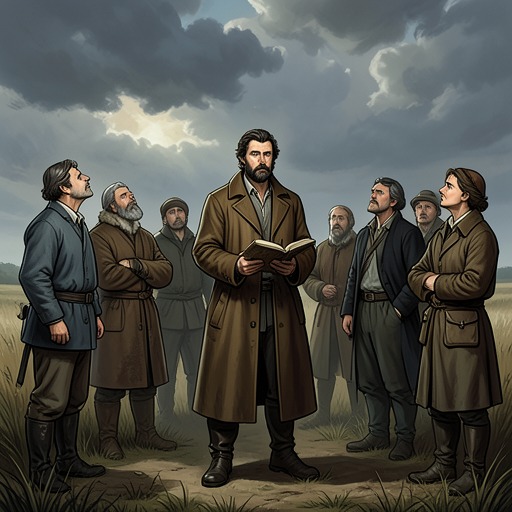
John Taylor
Under the Banner of HeavenJohn Taylor’s life joined personal loyalty to Joseph Smith with an uncompromising defense of plural marriage. Gravely wounded during the attack that killed Joseph and Hyrum Smith, Taylor survived, later led the church, and became central to the story of how the principle continued after official church policy turned against it.
The Carthage Jail Attack and Survival
On June 27, 1844, Taylor was visiting Joseph and Hyrum Smith in their quarters at Carthage Jail, alongside Willard Richards, when about 125 militiamen from Warsaw returned to town and attacked the jail. The Carthage guards offered little protection: their muskets had been loaded with blanks, and they stepped aside after firing them, allowing the attackers to enter the building.
As the attackers tried to force their way into the room, Taylor and Richards took positions beside the partly opened doorway and used walking sticks to strike at the muskets pushed through it. Hyrum was killed, and Joseph fired a smuggled revolver before attempting to escape through a window. Taylor, too, tried to get out; he was shot and fell, seriously wounded. Richards survived and later found Taylor still alive. The watch in Taylor’s vest pocket had stopped at 5:16:26 p.m., a time and date later remembered by Latter-day Saints as marking Joseph Smith’s death.
Church Presidency and Resistance to Federal Pressure
Taylor’s survival at Carthage became part of a longer record of personal loyalty to Joseph Smith. Their first encounter had left Taylor convinced of the prophet’s authority: Joseph had grasped his hand, and Taylor later described feeling what he took to be an electric current pass up his arm. At the jail, Taylor had been close enough to witness the attack and was gravely wounded himself. His devotion to the church and to Joseph’s doctrines shaped his conduct when he succeeded Brigham Young as president in 1877: Taylor regarded abandoning plural marriage to appease the federal government not as a practical compromise, but as a betrayal of sacred principle.
As pressure on the church intensified, Taylor answered the government in explicitly religious terms. In 1879 he warned that the nation would face further bloodshed and devastation, and rejected the claim that monogamy should be imposed on the Saints. At a Sunday assembly in Great Salt Lake City on January 4, 1880, he declared that when the United States and heaven came into conflict, the Saints would side with heaven. He then asked those who shared his position to raise their hands; the vast assembly did so. The gesture made his authority visible as a collective commitment, while setting the church’s religious claims directly against federal law.
Federal policy tightened around that defiance. The Edmunds Act of 1882 made prosecution for unlawful cohabitation possible even where plural marriage itself was difficult to prove. Federal agents pursued such cases across Utah, and by the late 1880s about a thousand Saints had been jailed. Taylor responded not by withdrawing his support for plural marriage, but by sending members to settlements in the American West, Mexico, and Canada, where they hoped to live with less risk of arrest. Colonies grew at Cardston in Alberta and near the Sierra Madre Occidental. When a warrant was issued for Taylor in 1885, he too went into hiding.
Even in hiding, Taylor continued to defy the campaign against plural marriage. In 1886, at seventy-eight, he married twenty-six-year-old Josephine Roueche, his sixteenth wife. The federal government’s pressure continued: Congress passed the Edmunds-Tucker Bill in March 1887, and after Taylor died later that year, federal lawyers began proceedings aimed at the church’s property. His presidency thus ended without a settlement between the competing claims of divine and civil authority; his refusal to yield would also become a foundation for later Mormon Fundamentalists.
The 1886 Revelation and Its Legacy
While hiding from federal agents, Taylor received a revelation on September 26, 1886, affirming that the commandment concerning plural marriage had not been revoked and remained binding. The account became a key authority for Mormon Fundamentalists, who argued that the later Manifesto suspended plural marriage only under exceptional circumstances rather than canceling the doctrine. Its authenticity was angrily disputed by leaders of the mainstream church.
Taylor promptly shared the revelation with trusted members in a meeting at the home of John W. Woolley. He placed those assembled under a covenant to defend celestial or plural marriage, dedicating their lives, liberty, and property to sustaining the principle. Taylor warned that some might be ostracized or expelled by fellow church members, and that some could lose their lives for their commitment. He authorized five of those present to perform celestial marriages and to authorize others to do so, intending to ensure that plural marriages would continue.
The meeting lasted eight hours. As it ended, Taylor prophesied that during the church’s seventh presidency it would fall into temporal and spiritual bondage, and that the figure described in Section 85 of the Doctrine and Covenants as the One Mighty and Strong would then appear. Fundamentalists later made this prophecy, and the revelation and covenant behind it, part of their account of a sacred duty surviving the church’s change of policy. Taylor’s defense of plural marriage thus extended beyond his own presidency: it supplied later dissenters with a claimed authorization to preserve the practice against both federal pressure and the mainstream church’s course.
Succession, Testimony, and the Afterlife of Vengeance
After Joseph Smith’s death, Taylor stood with the apostles who wanted the next church leader to uphold plural marriage. The doctrine remained secret from most Mormons: in the confused days after the killing, the great majority did not know that Joseph had taken plural wives or taught that the practice was essential to entering the Kingdom of Heaven. The struggle over succession was therefore also a struggle over whether the hidden doctrine would survive its founder.
Taylor and Willard Richards had witnessed the attack at Carthage, but when seven defendants were tried in 1845, both refused to appear, fearing they would be killed if they returned to Carthage. The defendants were acquitted. On the first anniversary of Joseph’s death, Brigham Young responded by directing church authorities to establish an Oath of Vengeance in the temple endowment ceremony. The vow remained in the ritual until 1927, when it was removed after its disclosure provoked public and political outrage. Taylor’s place in these events was that of a surviving witness and an apostle committed to preserving Joseph’s plural-marriage doctrine, a commitment that later shaped his own presidency and the fundamentalist legacy attributed to his revelation and covenant.